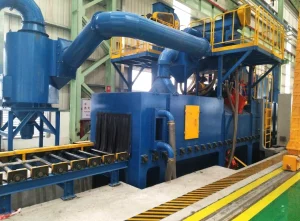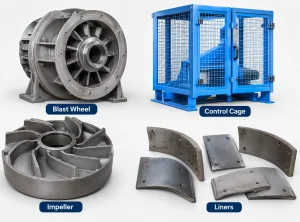

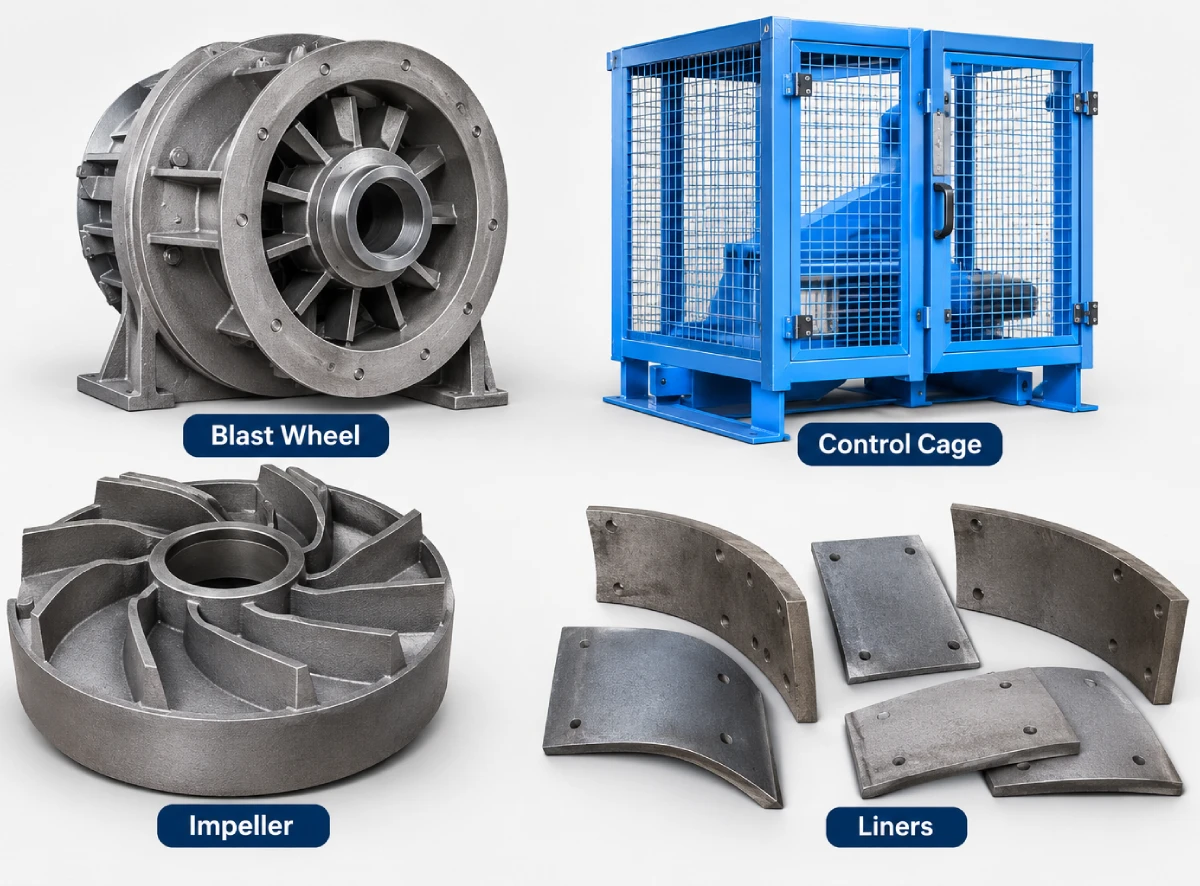
Abrasive blasting equipment consists of several interconnected components that control media movement, surface cleaning, material recovery and dust extraction. These include the blast wheel assembly, impeller, control cage, blades, chamber liners, bucket elevator, abrasive separator, dust collector, work-handling system and control panel. Understanding the function of individual shot blasting machine parts helps identify wear, maintain consistent blasting performance and prevent unexpected equipment downtime.
Since 2003, Wewin has been involved in the industrial finishing equipment sector, covering blasting facilities and related finishing systems. We examined the engineering functions of key blasting components, how they work together, common signs of wear and essential maintenance considerations.
Quick summary
The main parts of a shot blasting machine are the components that throw the abrasive, hold it inside the machine, recycle it and clean the air. Which parts are present depends on whether the machine is a wheel blasting machine or an air assisted blasting machine.
| Machine Part | Primary Function | Typical Machine Type |
|---|---|---|
| Blast wheel assembly | Accelerates and throws abrasive media onto the workpiece | Wheel blasting |
| Impeller | Feeds abrasive media toward the control cage | Wheel blasting |
| Control cage | Sets where the abrasive leaves the wheel and so the blast pattern | Wheel blasting |
| Blast wheel blades | Accelerate abrasive media as the wheel rotates | Wheel blasting |
| Chamber liners | Protect the internal chamber from abrasive wear | Both |
| Bucket elevator | Lifts recovered abrasive back to the top of the machine | Wheel blasting |
| Abrasive separator | Separates reusable abrasive from dust and broken media | Wheel blasting |
| Dust collector | Captures airborne dust generated during blasting | Both |
| Work-handling system | Moves, rotates or holds the components being blasted | Both |
| Blast nozzle, hose and metering valve | Accelerate and control abrasive using compressed air | Air assisted blasting |
| Control panel | Manages machine operating functions | Both |
Only the parts that fit your machine’s design are relevant. A tumble blast machine, for example, will not use the same work-handling parts as a roller conveyor machine.
Shot blasting machine parts work as a closed loop: abrasive is thrown, strikes the part, falls, is lifted, cleaned and thrown again.
Because this is a loop, wear or failure in one part affects the others. A worn separator, for instance, sends dusty or broken abrasive back to the wheel, which in turn wears the blades and cage faster.
The blast wheel accelerates abrasive media and directs it toward the workpiece. It is the central component of a centrifugal (wheel) shot blasting machine. Wewin describes its wheel blasting machines as high-velocity, high-efficiency systems that typically offer quick cycle times and use metallic abrasives in different hardness grades.
A blast wheel assembly generally includes:
The number of wheels needed on a machine depends on the parts being blasted and the required production rate.
The blast wheel throws the abrasive; the impeller feeds it. The impeller sits inside the control cage and distributes abrasive from the feed spout to the cage opening, where it passes onto the blades.
| Feature | Blast Wheel | Impeller |
|---|---|---|
| Role | Accelerates and throws abrasive | Feeds and distributes abrasive |
| Position | Outer rotating assembly with blades | Inside the control cage |
| Contact with abrasive | Blades receive and throw abrasive | Passes abrasive to the cage opening |
| Effect when worn | Reduced throwing speed and uneven blast | Irregular feed, affecting the blast pattern |
The two are matched parts, so a replacement impeller should suit the wheel and cage it works with.
Blast wheel blades (also called vanes) grip abrasive on the spinning wheel and accelerate it outward. They are among the parts that wear fastest because every piece of abrasive slides across them at speed.
Chamber liners protect the machine’s internal structure from abrasive impact. Without them, rebounding abrasive would wear through the chamber walls.
Check liners at regular intervals, especially around the blast pattern’s main impact zone.
The abrasive recovery system collects used abrasive from the chamber floor and returns clean, reusable abrasive to the blast wheel. This is what makes shot blasting economical, because the abrasive is reused many times.
It typically consists of:
A dust collector captures the airborne dust created by blasting so the machine, the workplace and the surrounding air stay cleaner. It also works with the separator to carry fine dust away from the recovered abrasive.
An air assisted blasting machine uses compressed air to accelerate abrasive through nozzles, which gives control over blasting pressure and coverage. Wewin notes this approach suits complex shapes, internal surfaces and lower-volume work.
| Part | Function |
|---|---|
| Blast nozzle | Directs and shapes the abrasive stream |
| Blast hose | Carries abrasive and air to the nozzle |
| Abrasive metering valve | Controls how much abrasive enters the air stream |
| Pinch valve sleeves and seals | Open and close abrasive flow; wear from abrasive contact |
| Blast pot or pressure vessel | Holds abrasive and supplies it under pressure |
| Dust collector and filters | Control dust in the blasting area |
Nozzles, hoses and valve sleeves are the main consumable parts in this type of machine, because abrasive passes directly through them.
Work-handling parts present the components to the blast stream. Wewin lists typical wheel blast machine formats as tumble blast, swing table blast, spinner hanger blast, roller conveyor blast and multi-table blast.
| Machine Format | Handling Approach |
|---|---|
| Tumble blast | Components tumble in a drum or belt so all sides are exposed |
| Swing table blast | Components sit on a table that swings into the blast zone |
| Spinner hanger blast | Components hang and rotate in the chamber |
| Roller conveyor blast | Components travel along a roller conveyor through the machine |
| Multi-table blast | Several tables allow loading and blasting in turn |
The handling parts to watch (conveyors, rollers, belts, hangers, tables and their drives) differ in each format, so list your machine format whenever you enquire about parts.
Shot blasting machine parts affect performance through blast pattern, abrasive condition, airflow and cycle consistency.
| Symptom | Possible Part Involved |
|---|---|
| Uneven cleaning or patchy finish | Control cage, blades or impeller wear |
| Longer blasting time for the same result | Worn blades, low abrasive quality or poor separation |
| Rapid wear on chamber walls | Worn or misaligned control cage; damaged liners |
| Dust escaping the machine | Dust collector filters, seals or airflow issue |
| Dusty or broken abrasive in the hopper | Separator problem or filter issue |
| Abrasive leaking from the machine | Worn liners, seals or door components |
| Unusual vibration | Unbalanced wheel or uneven blade wear |
| Rising power use | Wear in drives or reduced efficiency of the wheel |
These are common indicators rather than diagnoses. A trained technician should confirm the cause before parts are replaced.
Replace a component when inspection shows it can no longer do its job reliably, not only when it fails outright. Typical triggers are:
The parts most commonly replaced include blades, control cages, impellers, liners, filters and belts. Replacement intervals depend on the abrasive used, the components blasted and operating hours, so follow the machine manufacturer’s guidance rather than a fixed schedule.
To order the right part the first time, supply details that identify the machine and the exact component.
Parts-order checklist
Important: Compatibility depends on the specific machine design. Wewin notes that availability of specific parts depends on the machine model and application, so confirm details with the manufacturer before ordering.
Shot blasting is the first step in many coating lines. The surface profile it creates helps paint adhesion and coating durability, so blasting part condition has a knock-on effect downstream.
| Stage | Related Wewin Equipment |
|---|---|
| Surface preparation | Shot blasting |
| Pre-treatment | Pre-treatment plants |
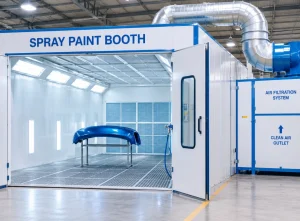
| Painting | Liquid spray booths, powder spray booths |
| Curing | Ovens |
If an older machine needs more than part replacement, Wewin’s group includes Wewin Enterprises, which handles retrofitting and rebuilding.
The main parts are the blast wheel assembly, impeller, control cage, blades, chamber liners, bucket elevator, abrasive separator, dust collector, work-handling system and control panel. Air assisted machines instead use nozzles, hoses and metering valves.
Blades, control cages, impellers, liners, filters and belts are the parts most often replaced, because they are in direct contact with abrasive or dust.
A control cage controls where abrasive is released onto the blades, which sets the blast pattern and directs abrasive toward the workpiece.
Signs include uneven or slower cleaning, vibration, reduced blast intensity and visible thinning or damage when the blades are inspected.
Liners absorb impact from rebounding abrasive. When they thin or crack, abrasive can damage the chamber structure, so worn plates should be replaced promptly.
It removes dust, scale and broken abrasive from recovered media so only reusable abrasive returns to the wheel.
It depends on abrasive type, material blasted, operating hours and machine design. Follow the inspection guidance and replace parts based on measured wear and performance.
Provide the machine type and model, wheel configuration, part name and location, measurements or a sample, and the abrasive used.
Wewin can support customers with shot blasting machine components and related requirements, and part availability depends on the machine model and application.
Wheel blasting relies on blast wheels, impellers, control cages and blades. Air assisted blasting relies on compressed air, nozzles, hoses and metering valves.
If you need a part or are planning a replacement, contact us to discuss your requirements.