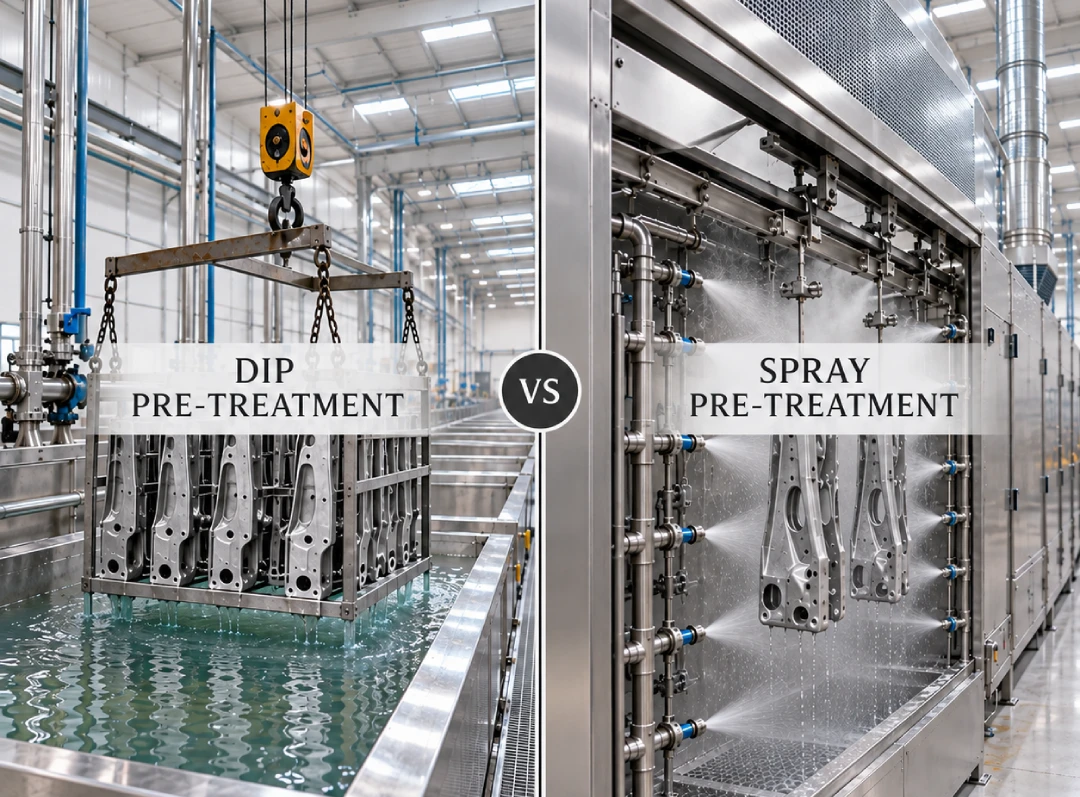
Dip pre-treatment immerses parts in chemical tanks and suits complex shapes, cavities and batch production. Spray pre-treatment sprays parts moving through a conveyor tunnel and suits high-volume, open-profile components. Choose based on part geometry, production volume and line layout.
A coating is only as good as the surface beneath it. Even the best powder or liquid paint will peel, blister or corrode early if oil, dirt, rust or weld residue is left on the metal. That is why a pre-treatment plant sits at the start of almost every serious finishing line, and why the first decision manufacturers face is whether to choose a dip pre-treatment plant or a spray pre-treatment plant.
Both methods clean and prepare metal for coating. They differ in how the chemicals reach the component, and that difference affects cost, floor space, production speed and the quality you get on complex parts.
What Does a Pre-treatment Plant Do?
A pre-treatment plant cleans and conditions components before painting. A typical process includes degreasing, rinsing, a conversion or surface-conditioning stage, further rinsing and a final drying step. The exact stages and chemicals depend on the base material, the type of paint and the performance you need.
The result is a chemically clean surface that allows paint to bond properly, which improves adhesion and corrosion resistance and reduces rework.
How Does Dip Pre-treatment Work?
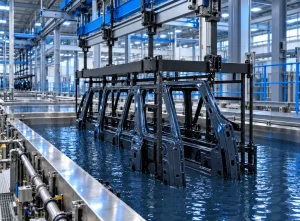
In a Dip Pre-treatment system, components are lowered into a series of tanks, each holding a different chemical or rinse. Parts are held in each tank for the required time and then moved to the next one, either manually or through a material handling system.
Where dip systems work well
How Does Spray Pre-treatment Work?
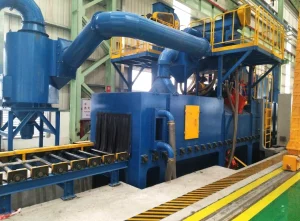
In a Spray Pre-treatment system, components travel through a tunnel on a conveyor while nozzles spray chemicals at controlled pressure and temperature. Each zone handles one stage, and the final zone typically removes water before the part enters the drying oven.
Where spray systems work well
Points to consider
Dip vs Spray Pre-treatment: What Are the Differences?
How Do You Choose Between Dip and Spray?
There is no universal winner. The right plant depends on your components and your production plan. Wewin designs pre-treatment plants around factors such as:
Working through this list with an equipment manufacturer early prevents costly redesign later.
What Design Features Should a Pre-treatment Plant Have?
A pre-treatment plant runs with corrosive chemicals and heat every day, so construction quality matters. Wewin’s pre-treatment plants include features such as:
Why Choose Wewin for Pre-treatment Plants?
Wewin has served the finishing industry since 2003, supplying equipment and turnkey solutions for automotive, foundry, valve, wood and general engineering sectors. Our capabilities cover design, manufacturing, supply, erection and commissioning, so your pre-treatment plant is engineered to work with your ovens, booths and material handling from day one.
Talk to Wewin to find out whether a dip or spray pre-treatment plant suits your components and production targets.
FAQs
1. What is the difference between dip and spray pre-treatment?
Dip pre-treatment immerses components in chemical tanks, while spray pre-treatment sprays chemicals onto components moving through a tunnel.
2. Which is better for complex parts?
Dip systems usually give better coverage on cavities, recesses and complex geometries.
3. Which is better for high-volume production?
Spray systems on a conveyor generally suit continuous, high-volume lines.
4. Can a spray pre-treatment plant be expanded later?
Yes. Wewin’s spray pre-treatment plants use modular construction, so they can be extended or reduced and re-erected when needed.
5. Does Wewin supply pre-treatment plants as part of a complete line?
Yes. Wewin provides turnkey finishing solutions including pre-treatment, ovens, spray booths and related equipment.