
The choice between automatic and manual shot blasting machines can directly influence production capacity, labour requirements, surface consistency, and operating costs. While manual systems can work well for smaller or specialized applications, automated shot blasting becomes increasingly valuable as production volume and consistency requirements increase.
The right solution depends on the component, production rate, handling requirements, available workforce, and desired level of process control.
Wewin provides shot blasting systems for automotive, foundry, fabrication, and general engineering applications, including solutions designed around different production and automation requirements.
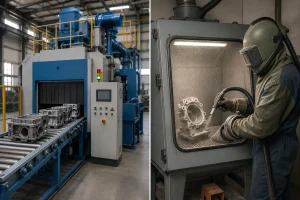
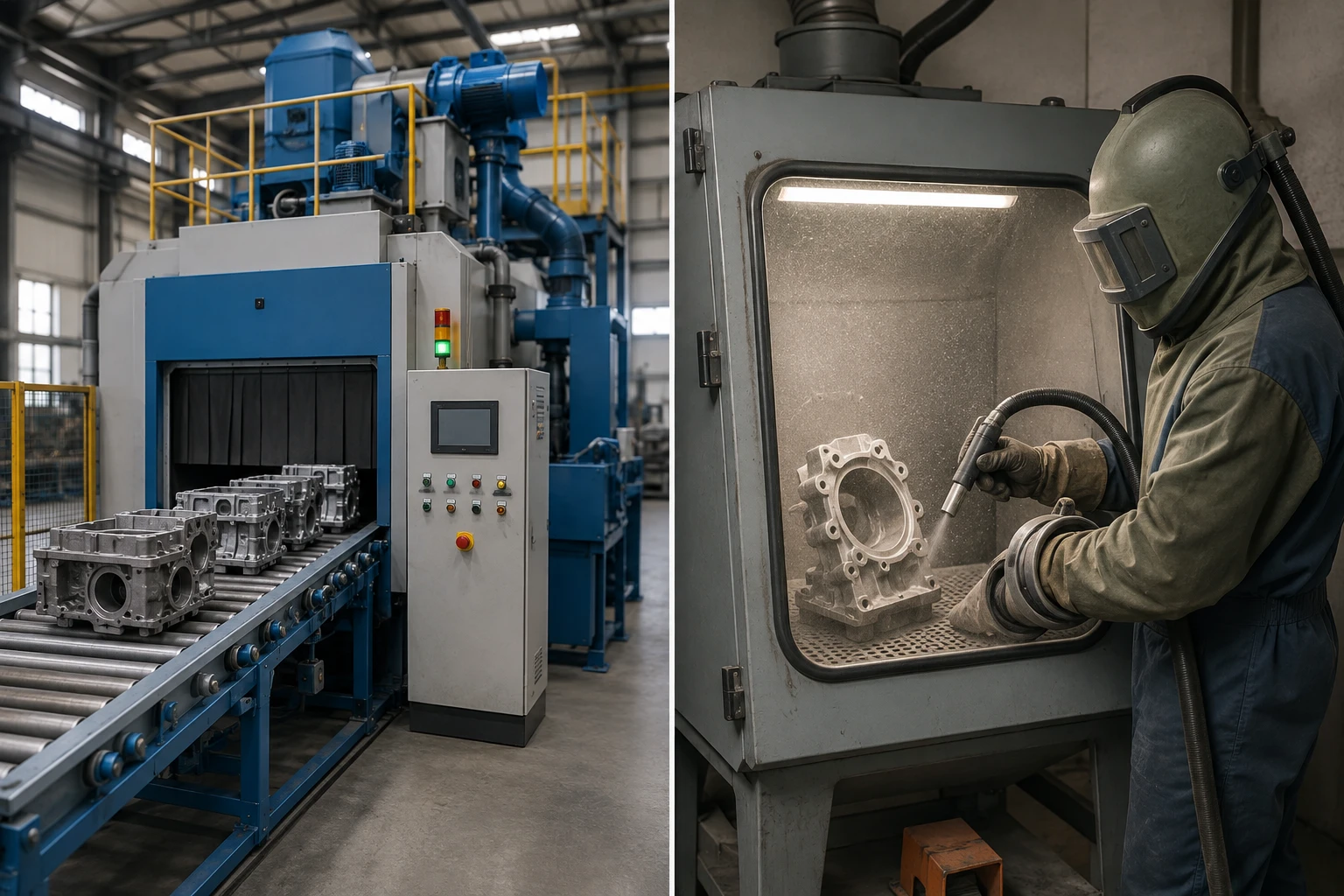
Manual blasting requires operators to load, position, or handle components during different stages of the process.
It can be suitable for:
Advantages
Limitations
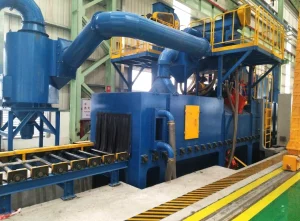
An automatic shot blasting machine integrates material handling and process controls to reduce operator intervention.
Depending on the application, automation can include:
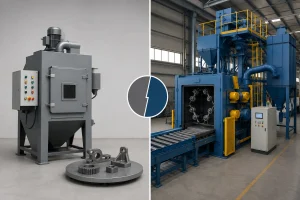
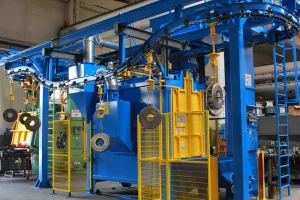
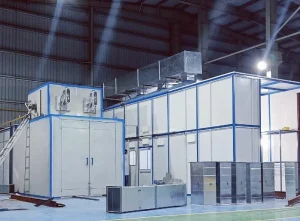
Wewin’s wheel blasting systems include configurations such as tumble blast, swing table, spinner hanger, roller conveyor, and multi-table machines, allowing different levels of production automation.
Production capacity is one of the biggest differences.
Manual processing depends heavily on:
Automatic systems can maintain more consistent cycle times and integrate with conveyors or production lines.
For high-volume manufacturing, this can make automation a significant productivity advantage.
Surface preparation must be consistent when components will later undergo painting, coating, welding, or other finishing processes.
Automatic systems can maintain controlled:
This reduces variation caused by manual operation and can improve repeatability across production batches.
Manual machines generally require greater operator involvement.
As production increases, manufacturers need to consider:
Automation can reduce repetitive manual tasks and allow personnel to focus on monitoring, inspection, and other production activities.
Manufacturers do not necessarily need a completely automated production line.
There are several levels:
Operators load components while the machine controls the blasting cycle.
The machine integrates conveyors, fixtures, or automatic loading and unloading.
The blasting system becomes part of a broader automated manufacturing line.
The appropriate level depends on production requirements and investment objectives.
Before selecting an automatic or manual shot blasting machine, evaluate:
Wewin designs and manufactures shot blasting equipment for demanding industrial applications and provides complete project support from design and manufacturing to installation and commissioning.
Wewin’s solutions can support manufacturers looking for:
For manufacturers with existing equipment, Wewin Enterprise also provides rebuilding, retrofitting, and modification services aimed at improving machine productivity and availability.
For high-volume and repetitive production, automation generally offers greater productivity and consistency. Manual systems can be more practical for smaller or highly variable production.
Yes. Automatic loading, unloading, handling, and process controls can reduce repetitive manual work.
Yes. Automated systems are particularly useful for automotive production where high throughput and repeatable surface preparation are required.
Yes. Manual or semi-automatic systems can be practical when production volumes are lower and component variations are frequent.
Depending on the machine condition and design, retrofitting or modification may be possible. An engineering assessment is recommended before deciding.
Wewin provides application-specific shot blasting systems and can support design, manufacturing, installation, commissioning, and equipment modification requirements.
The decision between automatic and manual shot blasting machines should be based on production volume, component variation, quality requirements, labour costs, and future expansion plans. Manual systems can provide flexibility for smaller operations, while automation becomes increasingly valuable when manufacturers need higher throughput, repeatability, and reduced manual handling.